
Introduction
This knowledge-sharing session is intended to
- help students, graduates, and early-professionals understand the difference between changing jobs for the wrong reasons and making intentional career moves. It will explore the potential consequences of each approach and provide insights into how strategic career decisions can lead to long-term professional growth, fulfillment, and success
- encourage individuals to adopt a more purposeful, informed, and disciplined approach to career development—one that focuses not merely on moving from one job to another, but on building expertise, creating value, expanding professional impact, and achieving long-term career success.
- help experienced professionals who find themselves on misaligned career paths to reposition their careers, overcome career stagnation, and provide more effective guidance and mentorship to others.
- help job seekers better understand the realities of career progression, enabling them to make more informed career choices, manage their expectations effectively, and reduce the frustration, disappointment, and recurring setbacks often associated with job searches, interviews, promotions, and career advancement opportunities.
Changing jobs is not necessarily the same as growing or advancing your career. How and why you change jobs matters.
What does your career history reveal about your pattern of job transitions and career progression?
- Are you moving to a new organisation while remaining at the same level?
- Are you stepping into a higher position without first developing the competencies required for the new role? or
- Are you advancing into a more senior position with the skills, experience, and capabilities needed to succeed?
The career movement pattern an individual follows is often evident in their CV. During the recruitment process, hiring managers and recruiters can usually identify whether a candidate’s career progression reflects deliberate capability building, lateral movement, or advancement beyond their demonstrated competencies.
True career progression is not measured by the number of job changes, but by the growth in responsibility, competence, and impact that accompanies each move.
Research shows that professionals typically change jobs through the following pathways:
- a) Job Rotation.
- b) Horizontal Hopping.
- c) Vertical Hopping.
- d) Strategic Hopping.
a) Job Rotation – Deliberate movement between roles in different business units within same organisation to broaden experience. This is not often considered a risk.
b) Horizontal Job Hopping – Moving to similar roles with comparable responsibilities in different organisations.
c) Vertical Job Hopping – Moving into higher roles in another organisation without necessarily possessing the core competencies to succeed in the new position.
d) Strategic Vertical Job Hopping – Moving into a higher role in another organisation with the requisite competencies to perform in the new role.
Poor decisions & career choices can steer professionals onto the wrong path, creating the illusion that frequent job changes or shortcuts will accelerate career growth. Understanding different career movement strategies and their hidden costs enable job seekers to anticipate recruiters’ concerns, address potential red flags, and prepare for challenging interview questions with confidence.
This discussion is about horizontal & vertical job hopping.
Frequent job hopping can sometimes result from poor career-transition decisions, & may create significant consequences for both the individual & the hiring organisation.
While frequent movement into new roles may provide immediate & attractive benefits, higher salaries, impressive job titles, or access to prestigious brands, sustainable career growth often delivers greater long-term rewards. However, achieving those rewards requires deliberate planning, thoughtful decision-making, continuous competence development, & disciplined execution.
What Is a Career Journey Risk?
A career journey risk is any event, decision, action, belief, or assumption that can negatively affect an individual’s long-term professional growth and success. Such risks may result in career stagnation, skills gaps, reduced adaptability, limited mobility, and fewer future opportunities.
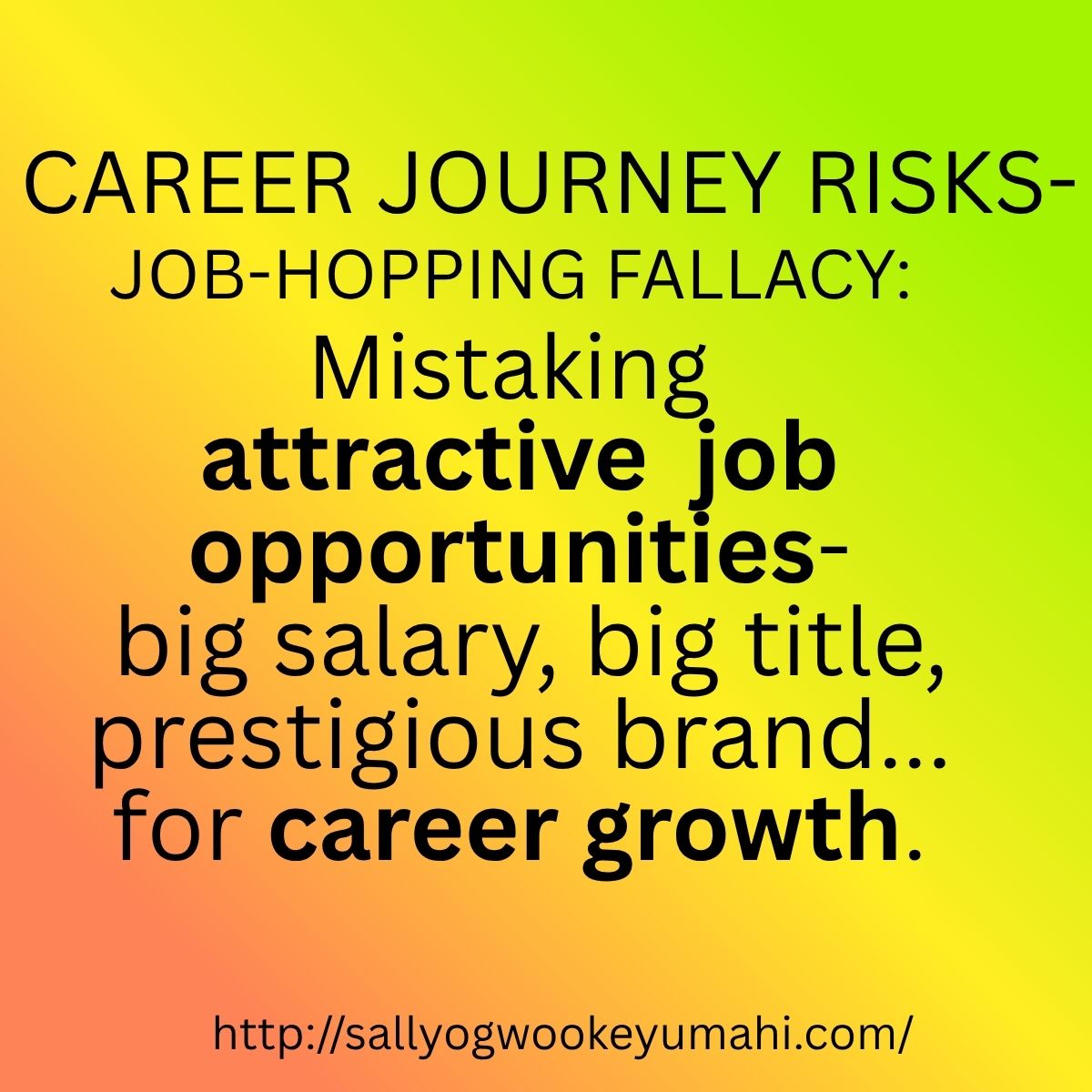
One of the most significant career journey risks is Job-Hopping Fallacy. The belief that frequent job changes, particularly those driven by attractive compensation packages, prestigious job titles, or well-known company brands automatically translate into career growth. This fallacy represents one of the most common self-induced career risks affecting students, graduates, early-career professionals, mid-career practitioners, and even seasoned executives.
This misconception is driven by several key factors, including:
- A lack of self-discovery and self-awareness;
- Inadequate career planning;
- Limited understanding of personal strengths, interests, and aspirations; and
- An unclear sense of purpose, direction, and long-term career objectives.
As a result, individuals may end up following prevailing trends or peer behaviors without deliberate reflection, often lacking full ownership and control of their career mindset and decisions.
Job-hopping should not be confused with deliberate structured job-rotation programmes implemented by organisations as part of talent development, succession planning, and business continuity strategies.
In deliberate job-rotation programmes, employees are intentionally exposed to different functions and departments to broaden their understanding of organizational operations, strengthen cross-functional collaboration, and reduce key-person dependency risks.
Even within structured job-rotation programmes, individuals should maintain clarity regarding the profession, discipline, or capability area in which they intend to build deep expertise and long-term competencies. Effective job rotation is a strategic development tool—not a substitute for professional specialisation.
As an experienced recruitment professional, I have observed that many professionals—particularly job seekers—mistakenly equate career progression with:
- Length of service or years spent in employment;
- Job titles attained;
- Promotions received;
- Salary increases earned;
- Academic and professional certifications acquired;
- The number of organisations worked for; and
- Having prestigious company names on their résumés and CVs.
While these may serve as visible indicators of career progression, they are not, by themselves, reliable measures of meaningful or sustainable career advancement.
Consequently, many professionals encounter vacancies for senior management, executive, or C-suite positions with attractive compensation packages and immediately assume they are qualified and ready for such opportunities.
