
A key question for reflections – What hidden recruitment risks do you believe clients underestimate the most?
A recruiter’s perspective based on real life experience and professional encounters.
Effectiveness is not measured only by outcomes; it is equally measured by the quality of the process that produces those outcomes.
The above statement reflects a fundamental principle of corporate governance, risk management, and internal control. It also reinforces the timeless saying that “the end does not necessarily justify the means”.
Sustainable organisational success depends not only on achieving results but also on ensuring that those results are produced through disciplined, ethical, transparent, and well-controlled processes.
This principle is particularly relevant in professional recruitment consulting.
The most common questions recruitment consultants and HR professionals receive from hiring hiring organisations are:
- Why are recruitment professional fees so high?
- Why should a recruitment firm choose public advertisement instead of direct headhunting, or vice versa?
- Why does a recruitment assignment sometimes take several weeks or even months to complete?
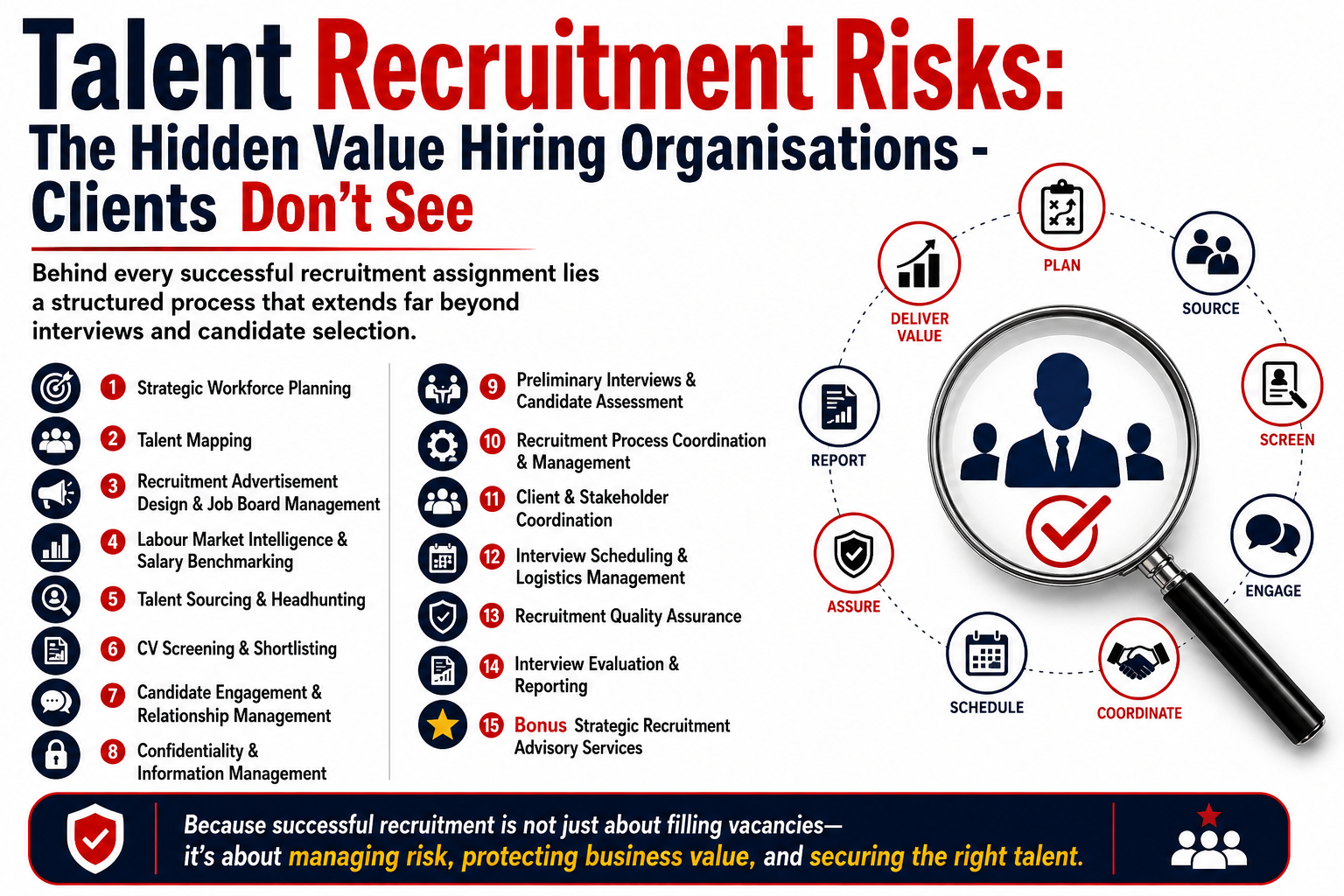
These questions reveal an important reality: many organisations see only the visible outcome of recruitment— the shortlist, interviews, and final report, but not the extensive professional work carried out behind the scenes.
In reality, the final recruitment report is merely the visible tip of the iceberg.
The true value in a recruitment engagement lies in the strategic planning, market intelligence, technical expertise, executive judgement, behavioural assessment, stakeholder management, and risk management activities completed long before the first candidate appears before an interview panel.
That invisible work is what makes recruitment a specialised professional consulting service and what clients are truly paying for.
Why Recruitment Costs Are Often Misunderstood
Much of the misunderstanding arises from limited appreciation of:
- Internal versus outsourced recruitment
- Public advertisement versus direct headhunting
- The professional processes involved
- The risks, timelines, costs, and benefits associated with each recruitment strategy
When organisations understand these factors, they are better positioned to make informed commercial decisions, appreciate the value delivered by recruitment professionals, and build stronger long-term partnerships.
Internal Recruitment or Outsourcing, which One is Cheaper?
Every organisation has two broad resourcing options for talent recruitment:
- Conduct recruitment internally.
- Outsource the assignment to a professional recruitment firm.
Both options involve costs:
- Professional Time Costs and
- Direct Recruitment Expenses
Professional time cost represents the value of the expertise and time invested by HR professionals, hiring managers, executives, and recruitment consultants throughout the recruitment process.
Direct Recruitment Expenses, typically include:
- Job advertisements
- Technology platforms and recruitment tools
- Telephone, internet, and communication costs
- Interview venues
- Printing and documentation
- Travel and logistics where applicable
Many organisations mistakenly believe internal recruitment is cheaper because they focus only on direct expenses.
However, recruitment consumes significant management and HR time that could otherwise be devoted to strategic organisational priorities. This opportunity cost is often overlooked.
Where specialist recruitment expertise is unavailable internally, organisations also face increased hiring risks, longer recruitment cycles, and poorer hiring decisions.
For these reasons, outsourcing recruitment may provide better value despite the professional fees involved.
Factors That Influence Recruitment Costs
Recruitment effort varies considerably depending on several factors, including:
- Seniority of the position
- Nature and complexity of the role
- Job location
- Availability of suitable talent
- Recruitment timeline
- Number of interview stages
- Number of candidates
- Confidentiality requirements
- Annual gross salary
- Recruitment strategy adopted
These factors determine the level of expertise, executive involvement, and professional time required.
How Recruitment Agencies Charge Professional Fees
Professional recruitment firms generally charge for two components:
Professional consulting services, covering the time spent understanding client requirements, developing recruitment strategies, sourcing talent, screening candidates, coordinating interviews, analysing performance, preparing reports, and managing the assignment.
Direct recruitment expenses, covering costs incurred during the assignment.
The costs must be stated in the sales proposal documents, agreed and signed by both parties. Some firms combine both into a single bill, while others invoice them separately. Both approaches are commercially acceptable.
Across many markets, recruitment professional fees typically range between 15% and 30% of the candidate’s annual gross salary, while lower-paid positions may attract fixed professional fees instead.
The Two Most Common Recruitment Strategies
- Public Advertisement and
- Direct Headhunting (Executive Search)
For Public Advertisements – Vacancies are publicly advertised through agreed channels, allowing interested candidates to apply voluntarily. Advantages include:
- Wider talent reach
- Larger applicant pool
- Lower sourcing cost
- Greater market visibility
However, this approach usually generates high application volumes requiring extensive screening, assessment, and shortlisting before qualified candidates emerge.
For Direct Headhunting (Executive Search)
Suitable candidates are identified and approached confidentially.
This strategy is particularly effective for executive, specialist, C-suite, and Board-level positions where many suitable candidates are passive job seekers.
Direct headhunting demands significantly greater executive involvement, relationship management, persuasion, confidentiality, and market intelligence. Consequently, professional fees are generally higher than those associated with public advertisement.
Neither strategy is inherently superior. The appropriate approach depends on:
- Commercial objectives
- Labour market conditions
- Position complexity
- Confidentiality requirements
- Availability of talent
In many cases, combining both approaches delivers the strongest outcome, but will require hire service fees to be charged
The Recruitment Process
Successful recruitment consists of two major phases.
- Phase One: Planning and
- Phase Two: Execution
Planning phase, typically includes:
- Understanding organisational needs
- Reviewing job descriptions and KPIs
- Identifying required competencies
- Agreeing recruitment strategy
- Preparing commercial proposals
- Defining timelines
- Establishing responsibilities
- Agreeing confidentiality provisions
- Replacement guarantees
- Refund and termination provisions
- Identifying commercial and operational risks
Phase Two: Execution is the Execution and typically includes:
- Designing advertisements or headhunting strategies
- Talent sourcing
- Receiving applications
- CV screening
- Candidate pre-assessment
- Candidate shortlisting
- Client approvals
- Interview scheduling
- Stakeholder coordination
- Interview management
- Candidate evaluation
- Performance analysis
- Report preparation
- Final submission
Where agreed, post-recruitment services may include:
- Salary negotiations
- Background verification
- Reference checks
- Offer management
- Onboarding support
These services often attract additional professional fees where they fall outside the original scope.
Candidate Assessment
Effective recruitment evaluates both technical competence and behavioural capability.
Technical Competencies, commonly include:
- Educational qualifications
- Professional certifications
- Industry experience
- Functional expertise
- Leadership experience
- Executive and Board exposure
- Business achievements
- Stakeholder management
- Use of technology.
Behavioural and Leadership Competencies, commonly include:
- Integrity
- Honesty
- Transparency
- Accountability
- Leadership
- Communication
- Emotional intelligence
- Critical thinking
- Analytical ability
- Collaboration
- Self-awareness
- Professionalism
- Learning agility
- Time management
- Relationship management
- Self-discipline
- Ethiquettes
Selection criteria should always comply with applicable employment laws and equal opportunity principles while supporting the organisation’s long-term workforce strategy.
Where genuine business needs exist, organisations may legitimately consider factors such as succession planning, geographical coverage, language capability, workforce diversity, nationality or other lawful business requirements are publicly stated in the adverts.and asked during the interview sessons.
Limitations of Recruitment Agencies
Recruitment consultants can competently evaluate qualifications, experience, behavioural competencies, communication skills, and leadership potential.
However, only the hiring organisation—particularly the hiring manager—can ultimately determine whether a candidate possesses the depth of technical expertise required within its unique operational environment.
Candidate Replacement Guarantees
Many recruitment firms offer replacement guarantees where a successful candidate declines an offer or resigns within an agreed guarantee period.
While this provides additional assurance to clients, it also exposes recruitment firms to unrecovered professional time, operational costs, and commercial risk.
Contract Termination and Refunds
Where an assignment is terminated after work has commenced, any refund should reflect:
- Professional work already completed
- Direct expenses already incurred
- Contractual terms agreed before commencement
Managing Salary Variation Risk
An often-overlooked commercial risk arises where the final negotiated salary differs from the salary originally approved.
- If the salary increases, recruitment fees based on percentage pricing also increase.
- If the salary decreases, the recruitment consultant earns less despite having invested the same professional effort.
A practical solution is to agree upfront on either:
- A discounted percentage based on the approved salary; or
- A fixed professional fee regardless of subsequent salary adjustments.
This provides commercial certainty for both parties.
Conclusion
Recruitment is far more than advertising vacancies and conducting interviews.
It is a specialised professional consulting engagement that combines strategic workforce planning, labour market intelligence, executive advisory, behavioural assessment, technical evaluation, negotiation, governance, risk management, and talent acquisition.
Understanding the distinction between public advertisement and direct headhunting enables organisations to make better commercial decisions, appreciate the professional value delivered by recruitment consultants, and build stronger partnerships that lead to better hiring outcomes.
Questions for Reflection
For Hiring Organisations
- Which recruitment approach has delivered the best results for your organisation: internal recruitment or outsourcing?
- What factors influenced your decision?
For Recruitment Consultants and HR Professionals
- Which sourcing strategy consistently delivers better outcomes in your experience: public advertisement, direct headhunting, or a combination of both?
- How do your clients perceive your professional fees?
- What strategies have helped you communicate the value behind your recruitment services?
I look forward to reading your perspectives and experiences in the comments.
To read my other articles, visit https://sallyogwookeyumahi.com/
#Recruitment #TalentAcquisition #ExecutiveSearch #HumanResources #CorporateGovernance #RiskManagement #Leadership #BusinessConsulting #Hiring #WorkforcePlanning
