
The Governance Evolution
Founder-led family businesses around the world generally follow a similar governance journey.
Understanding where an organisation sits on this governance maturity continuum enables Boards, investors, lenders, consultants, regulators, employees, and assurance providers to establish realistic expectations and provide practical governance and management support.
Stage One: Founder-Centred Leadership
During the first three to five years, governance structures are usually informal or still evolving.
Policies, procedures, reporting lines, accountability mechanisms, and delegated authority may not yet be fully defined, documented, or implemented.
Most strategic and operational decisions are driven by the founder’s entrepreneurial instincts, experience, judgement, and relationships.
Even where a Board exists, the founder often remains responsible for:
- Strategic direction
- Capital raising
- Business development
- Stakeholder engagement
- Major negotiations
- Key investment decisions
- Overall organisational leadership
The founder frequently performs multiple roles simultaneously—Chairperson, Managing Director, Chief Executive Officer, Chief Financial Officer, strategist, chief marketer, chief negotiator, relationship manager, and principal decision-maker.
Close family members and trusted associates often support various functions while the founder retains overall authority.
At this stage, such concentration of responsibility is often both necessary and appropriate.
Stage Two: Governance Maturity
As the business expands, operations become more complex, revenues increase, regulatory obligations grow, and capital requirements become more sophisticated.
Eventually, the founder recognises that sustainable growth cannot depend on one individual alone.
This marks the beginning of governance maturity.
Formal governance structures are established and embedded, including:
- An effective Board of Directors
- Executive management structures
- Independent assurance functions
- Clearly documented policies and procedures
- Delegation of Authority (DOA) frameworks
- Internal controls and accountability mechanisms
The Board increasingly focuses on governance, oversight, and strategic direction, while executive management assumes responsibility for day-to-day operations.
Independent assurance functions—including internal audit, risk management, compliance, and external assurance—provide confidence to the founder, Board, investors, lenders, regulators, and other stakeholders that governance processes and business performance remain effective.
Decision-making becomes more structured, accountability improves, and authority is progressively delegated without compromising the founder’s vision and values.
I have witnessed this governance transition repeatedly during Board and Executive Committee (EXCO) meetings across organisations in diverse industries, both within Nigeria and internationally.
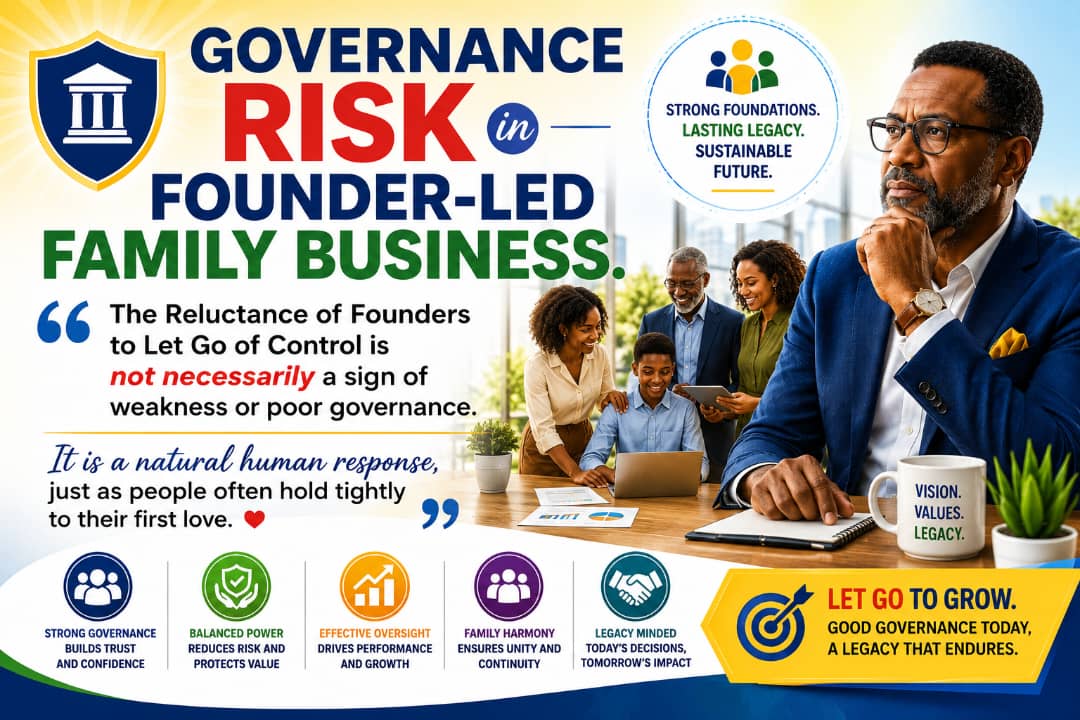
It is not a sign of weakness or loss of control.
Rather, it is a natural and necessary stage in the evolution of successful founder-led businesses.
