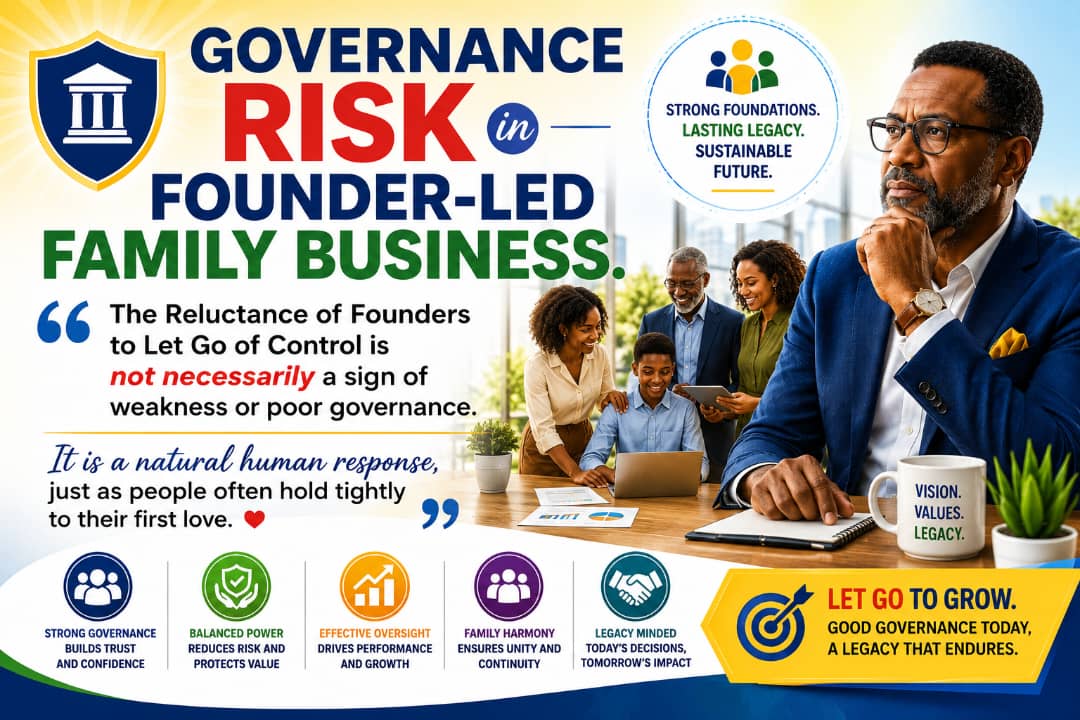

The role of good governance is not to replace the founder’s vision, but to preserve it, strengthen it, and ensure it endures long after the founder is gone.
Before criticising a founder’s reluctance to relinquish control, we should first appreciate the emotional investment, personal sacrifices, and entrepreneurial journey that gave birth to the business. Unfortunately, this perspective is often overlooked.
Many employees, consultants, investors, lenders, regulators, Board members, and assurance providers are quick to criticise founder-led businesses because founders appear unwilling to delegate authority or relinquish control, insisting on remaining involved in virtually every aspect of the organisation.
While this perception may sometimes be justified, it often ignores the realities of building and sustaining an enterprise from the ground up.
Transitioning from founder-centred leadership to a professionally governed and managed organisation is neither automatic nor easy. It presents genuine risks that may compromise the founder’s vision, values, entrepreneurial spirit, and legacy. Founders understand these risks and are naturally cautious about entrusting others with what they have spent years building.
Understanding these realities is essential if we are to support founders through a successful governance transition.
Why Is Letting Go So Difficult?
A founder’s reluctance to relinquish control is not necessarily a sign of poor governance or weak leadership. Rather, it is a natural human response—much like the instinct to hold tightly to one’s first love.
For founders, the business represents years of personal sacrifice, financial investment, sleepless nights, calculated risks, resilience, and unwavering commitment.
During the start-up phase, founders are often required to perform multiple roles simultaneously. They provide the capital, make strategic decisions, secure customers, negotiate contracts, recruit employees, manage cash flow, solve operational problems, and protect the organisation’s reputation.
Having invested their money, time, energy, reputation, and personal credibility, founders naturally develop a deep emotional attachment to the business. They feel personally responsible for protecting, nurturing, and growing it.
Before criticising this level of involvement, it is important to appreciate the unique bond between founders and the enterprises they have created.
However, founders must also recognise that long-term business sustainability cannot depend on one individual.
It depends on building:
- Effective governance systems
- Sound organisational structures
- Competent leadership teams
- Strong internal controls
- Well-designed succession mechanisms
These are the foundations upon which enduring institutions are built.
Family Ownership Is Not the Problem
There is absolutely nothing wrong with founders wanting ownership and control of their businesses to remain within the family.
The greater challenge is that many founders fail to intentionally involve their spouses and children during the formative years of building the business, even though the family enjoys the wealth and opportunities it creates.
As a result, when the founder retires, becomes incapacitated, or passes away, succession often becomes difficult.
Family members may inherit ownership without inheriting the knowledge, experience, discipline, business relationships, entrepreneurial mindset, decision-making capability, and resilience required to sustain the enterprise.
In many cases, they become beneficiaries of the business rather than builders of the institution.
