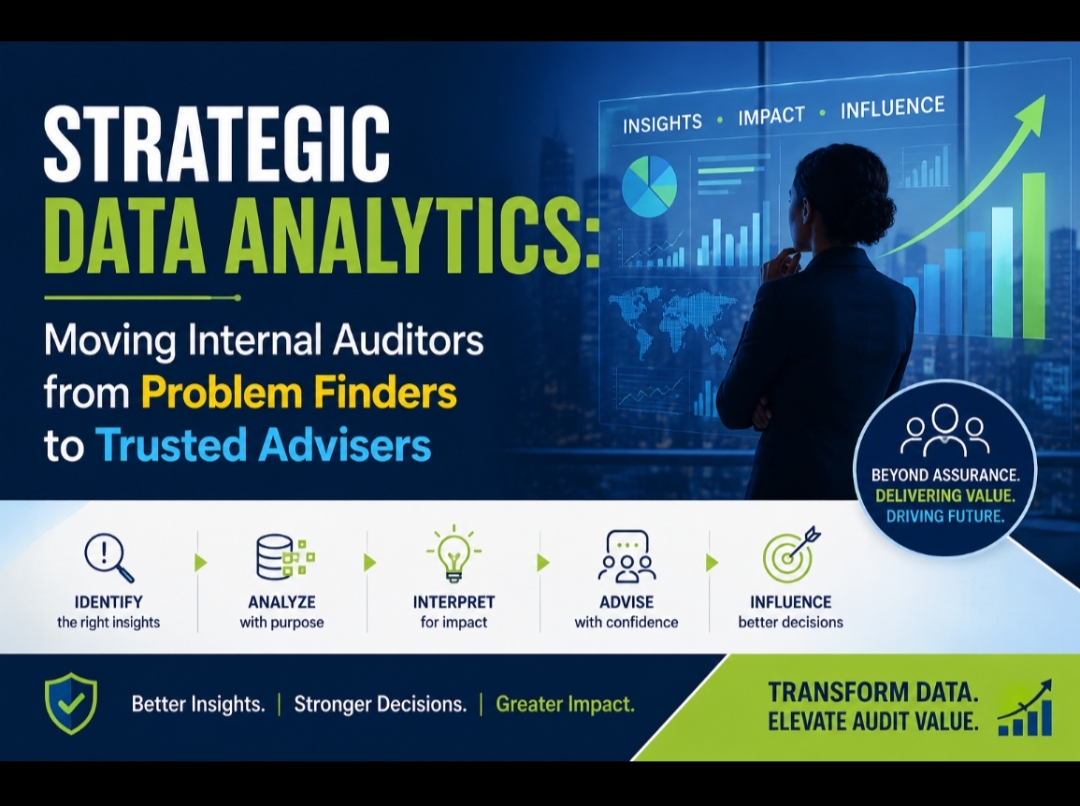

In risk assurance and advisory, sample testing of control design and operating effectiveness alone is not enough to conclude that controls are truly effective.
Leveraging data analytics provides deeper insights into the performance and effectiveness of control operations, enabling organizations to determine whether:
- Controls are operating effectively and consistently achieving their intended objectives.
- Boards and management can rely on timely, accurate information to make risk-informed strategic decisions.
- Internal audit is delivering measurable value and contributing meaningfully to organizational objectives.
- Internal audit is perceived merely as a useful function that identifies issues or as a valuable function – a trusted business advisor that provides strategic insights and drives continuous improvement.
Data analytics is also highly relevant in the statutory audit of financial statements, where auditors assess whether the financial statement assertions contain material misstatements arising from either unintentional errors or fraudulent activities. Statutory auditors use data analytics to identify anomalies, unusual patterns, and high-risk transactions that may require further investigation.
Data analytics should be far more than a visualization and reporting tool that merely explains the past. It should be a strategic capability that transforms assurance professionals—particularly internal auditors—from problem finders into trusted advisers, shifting the focus from retrospective reporting to value-driven foresight.
Strategic data analytics enables assurance professionals to generate descriptive, diagnostic, predictive, and prescriptive insights that improve business performance, strengthen governance, enhance risk management and internal controls, and support risk-informed strategic decisions and actions.
Rather than simply presenting dashboards and reports, strategic data analytics equips decision-makers with the insight and clarity to answer critical business questions:
- What happened?
- When did it happen?
- How did it happen?
- Who caused or influenced it?
- Where did it happen?
- Why did it happen?
- What is likely to happen next?
- What are the implications for current and future strategic objectives?
- What actions should Management, the Board, and other key stakeholders take?
The Challenge
Many assurance professionals mistakenly believe that proficiency in data analytics software alone is sufficient to perform value-driven audit analytics. Consequently, they focus primarily on describing historical events rather than generating strategic intelligence that informs future decisions.
Past mindset makes internal auditors Problem-Finders instead of Trusted-Advisers & limits the ability of internal auditors to:
- Anticipate emerging risks and opportunities.
- Assess the effectiveness of controls before failures occur.
- Evaluate the impact of risks on strategic objectives.
- Deliver predictive and prescriptive insights that support strategic decision-making.
- Provide value-driven recommendations that strengthen organizational resilience and sustainable growth.
In today’s dynamic business environment, organizations need auditors who do more than explain the past—they need trusted advisors who help shape the future.
