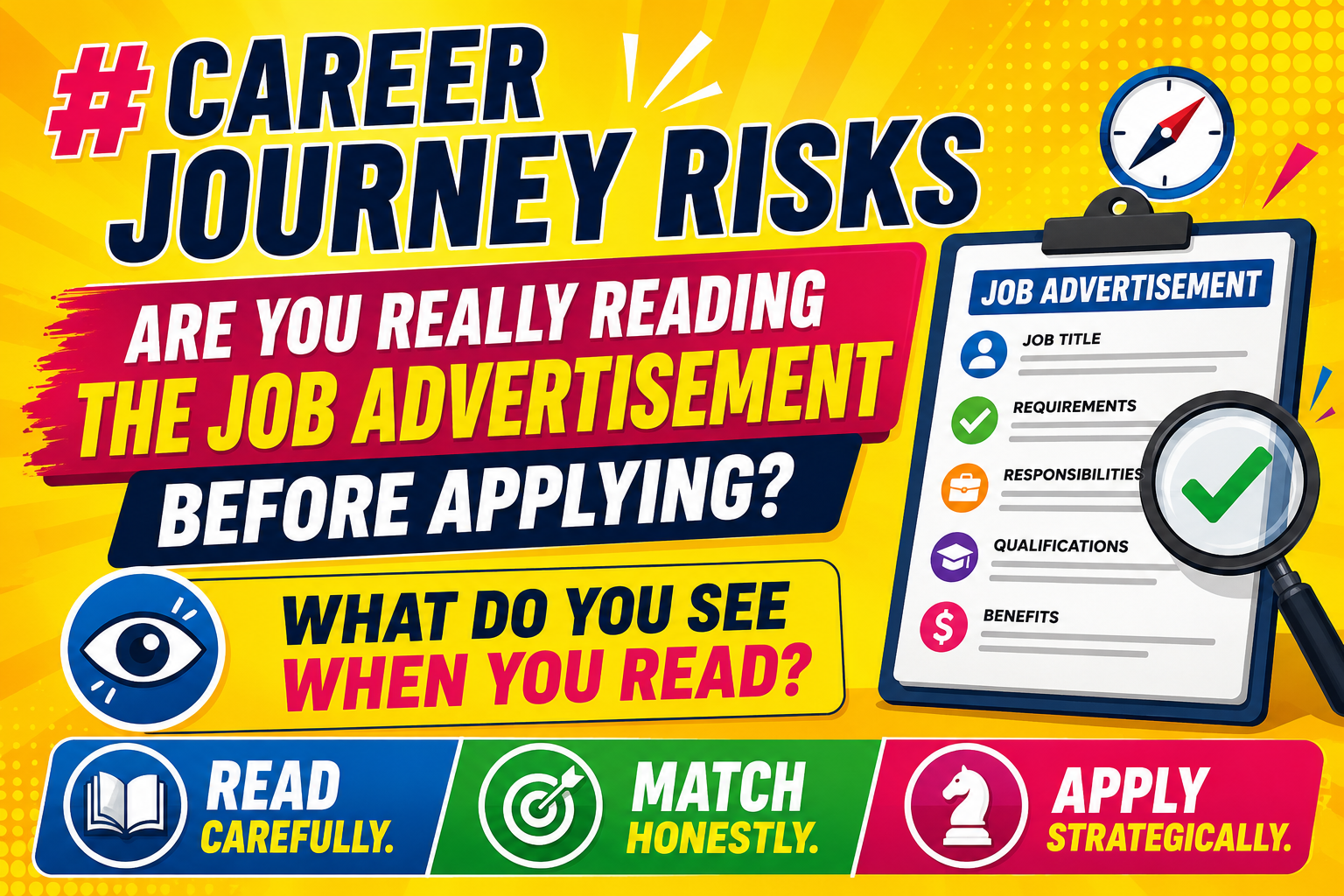

What do you actually see when you read a job advertisement?
We believe job seekers should present themselves professionally and strategically before recruiters. Doing so makes the recruitment process easier for both parties and significantly increases the applicant’s chances of securing the opportunities they desire. Unfortunately, current recruitment trends suggest that many applicants are not doing this.
Over a recruitment career spanning every organisational level, from boardroom executives to shop-floor employees, we have reviewed more than 100,000 CVs and interviewed over 20,000 job applicants. One mistake recurs more than any other, and it is perhaps the most avoidable: applying for jobs without carefully reading, understanding, and honestly assessing the advertisement against one’s qualifications, career level, and compensation expectations.
This seemingly simple oversight results in unnecessary rejection, wasted effort, missed opportunities, and, over time, a weakened professional reputation.
Every Job Advertisement Tells a Story
It communicates precisely what an employer is looking for, distinguishing mandatory requirements from desirable, nice-to-have qualifications. The mandatory requirements typically cover:
- Job title and key responsibilities
- Reporting line
- Required years, breadth, and depth of relevant experience
- Academic qualifications and, where applicable, professional certifications
- Relevant industry experience
- Job location and mobility or relocation requirements
- Age or gender requirements, only where legally permissible and genuinely justified by organisational, operational, workforce planning, or diversity objectives
- Salary range, benefits, and terms such as “subject to experience,” “performance-based,” or “negotiable.”
Yet it is remarkable how many applications bear little resemblance to the role advertised.
When the Application Doesn’t Match the Advert
Many CVs arrive without indicating the position applied for. Others are saved as “MyCV,” “CV Updated,” or “Final CV” instead of the applicant’s name—small details that make an application harder to identify and manage.
More concerning are applications where the candidate’s experience has no real connection to the vacancy. We have seen:
- Administrative Officers with under two years’ experience applying for Director-level roles.
- Seasoned CFOs applying for Sales and Marketing positions with no commercial experience
- Internal Audit professionals applying for senior Finance and Accounting roles on the strength of an accounting certification alone
- Construction Site Engineers applying for CEO roles in FMCG manufacturing because their degree is in Food Technology
- Digital Marketing professionals applying for C-suite Sales and Marketing roles in oil and gas, without formal sales or strategic marketing experience
- Corporate Legal Officers applying for senior Litigation Counsel roles with no practical litigation experience
Career transitions are certainly possible, but they require transferable competencies, deliberate planning, continuous learning, and a realistic progression pathway. Senior leadership is earned through the progressive acquisition of relevant skills, experience, and industry knowledge. Without that foundation, these applications rarely succeed.
The Ownership Question
Some candidates receive interview invitations that clearly state the job title and location, only to decline because the role is outside their preferred city. Asked whether they had read the advertisement, they often admit they hadn’t—a friend or relative simply forwarded the vacancy and encouraged them to apply.
This raises a fair question: are you taking ownership of your career, or letting others make that decision for you?
A recommendation from a friend may point you toward an opportunity, but it should never replace your own responsibility to understand the role. Before applying, every professional should independently review the advertisement and determine whether it genuinely aligns with their qualifications, aspirations, location, and compensation expectations. That is what career ownership looks like.
“Which Version of My CV Do You Have?”
When candidates are asked interview questions based on their own CV, this response comes up more often than it should. They maintain multiple versions and have applied so broadly they can no longer recall which one was sent for which role—a sign of an indiscriminate job search rather than a deliberate one.
Equally revealing: a Head of HR and Administration, with responsibilities and remuneration well above the advertised role, attends an interview only to discover the vacancy is far more junior than their current position. The job title, reporting line, responsibilities, and location were all clearly stated. The mismatch only becomes apparent in the room.
Did they actually read the advertisement before applying?
