
The roles of the company boards are to provide strategic oversight, direction and control over the company affairs to ensure growth and longevity.
Company laws require boards to exercise duty of skills and care, loyalty and obedience with utmost good faith in performing their roles, ensuring that board decisions do not cause loss to the company. These legal obligations are known as fiduciary duties of the board.
Boards rely on Value-Based information to keep abreast of the business events, performance against targets and make strategic decisions in line with their fiduciary duties.
Board directors are liable for breaching their fiduciary duties. Examples of such breaches are: negligent in taking appropriate decisions timely on matters that cause the company losses or bad reputation, corruption, fraud, abuse of positions or non-compliance to the applicable laws.
The Business Judgement Rule opines that board liability is not automatically enforced for every board decision that turn out bad. The enforcement is contingent on the inability of the board to demonstrate that their decisions were taken in utmost good faith and for the best interest of the company.
Proper documentation of the company’s standard operating procedures (SOPs), consistent operational enforcement, continuous reviews and updates are key evidence of boards’ readiness and commitment for performing their risk oversight and fulfilment of their fiduciary duties.
Risk management oversight is a key strategic oversight by boards.
The effective performance requires boards to have clarity and visibility of their company risk universe, performance against the established boundaries, and making good strategic decisions driving the company forward.
Value-Based board risk reporting provides the risk information required by the boards.
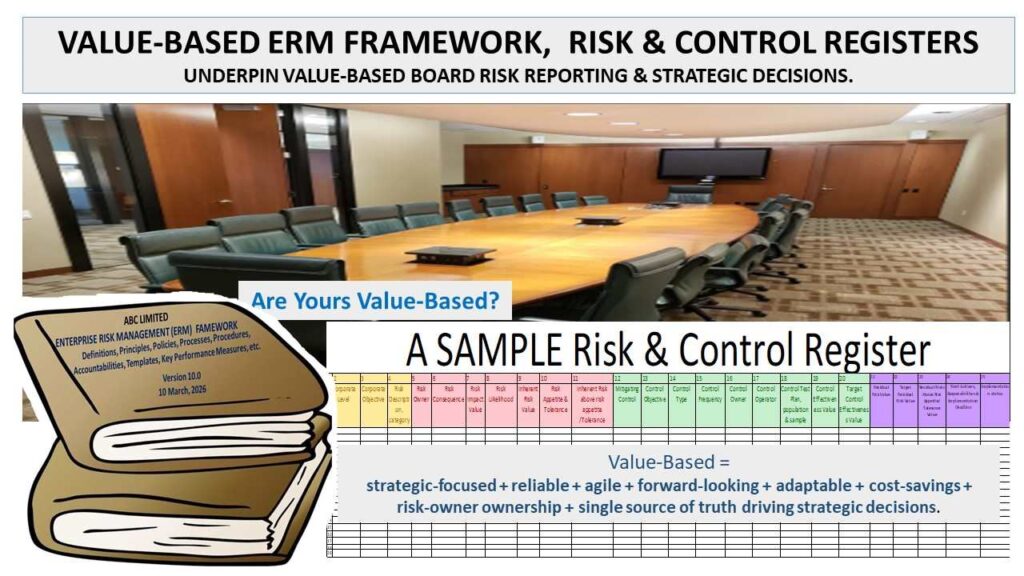
A Value-Based Enterprise Risk Management Framework (ERM Framework) and Risk and Control Registers /Matrices (RCM) are the bedrock for value-based board risk reporting and strategic decisions.
Value-Based = strategic-focus + reliable + agile + forward-looking + adaptable + cost-savings + single source of truth for strategic decisions.
The ERM framework, RCM, preparation and continuous updates must be owned by management with advisory support from assurance, and approved by board before operational use.
An effective Board interrogates the assumptions underlying their ERM framework, RCM and risk reports, and provide strategic feedback and guidance on areas of key concerns.
Management and assurance must demonstrate confidence to meaningfully engage with the board on governance and risk matters.
The key questions:
• Who owns your company’s ERM Framework & RCM?
• How value-based are they?
•How meaningful are your board engaged on governance and risk matters?
View our training on: >>> https://platinumedgeconsultingltd.com/view-all-our-upcoming-training-workshops-in-one-page
View other write ups: MANDATORY FOUNDATION FOR CREDIBLE BOARD RISK REPORTING & STRATEGIC DECISIONS. – Sally Ogwo Okey-Umahi